Ich bin Software Engineer mit Erfahrung in der Entwicklung moderner, hochgradig nebenläufiger verteilter Systeme sowie datenintensiver Anwendungen. Mein Schwerpunkt liegt auf der Backend-Entwicklung mit Python und Java, insbesondere im Aufbau skalierbarer Microservices, der Integration externer APIs und der Umsetzung robuster Softwarearchitekturen. Dabei arbeite ich analytisch und lösungsorientiert mit einem klaren Fokus auf Qualität, Zuverlässigkeit und Wartbarkeit komplexer Systeme.
In meiner beruflichen und akademischen Laufbahn habe ich an Systemen im Umfeld von Cloud-Plattformen, PKI-Infrastrukturen und Machine Learning gearbeitet. Besonders prägend war meine Masterarbeit im Bereich Machine Learning zur Biodiversitätsanalyse mittels Soundscape-Daten, in der ich datenintensive Verarbeitung mit Deep-Learning-Methoden und High Performance Computing kombiniert habe. Diese Verbindung aus Software Engineering und angewandter KI prägt mein technisches Profil.
Als Software Engineer liegen meine Interessen im Bereich Forschung und Entwicklung, insbesondere an der Schnittstelle zwischen Edge-Technologien und Methoden der Künstlichen Intelligenz sowie deren Integration in hochperformante, skalierbare und hochgradig parallele Softwaresysteme.
Mein Ziel ist es, innovative und wissenschaftlich fundierte Lösungen zu entwickeln, die reale Anwendungen nachhaltig und wirkungsvoll unterstützen.
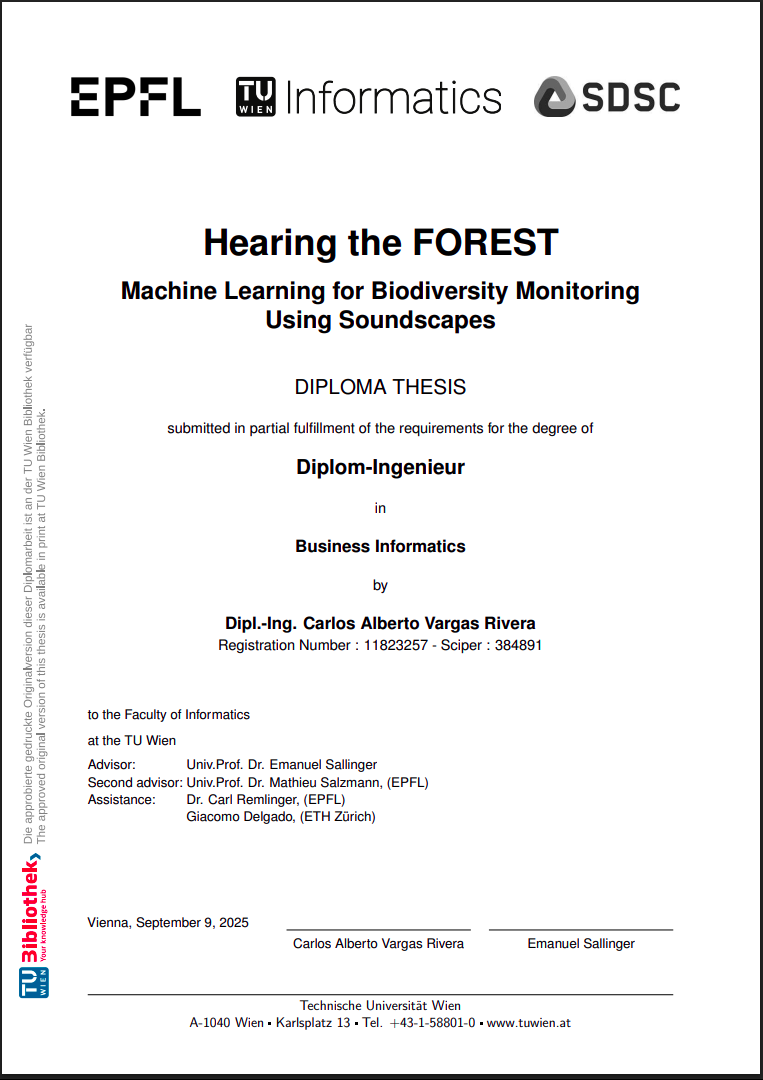
The 2030 United Nations Agenda for Sustainable Development highlights the urgent need to address biodiversity loss and land degradation, which threaten ecosystems and livelihoods worldwide. This thesis contributes to these efforts by supporting the Payment for Environmental Services (PSA) environmental conservation program in Costa Rica as a case study for large-scale biodiversity monitoring using Passive Acoustic Monitoring (PAM). We propose the FOREST (FramewOrk for featuRe Extraction, viSualisation, and classificaTion of Soundscapes), a modular Python-based framework that integrates preprocessing, dataset curation, feature extraction, visualisation, and predictive classification of ecological audio recordings. First, we establish a pipeline that transforms soundscapes into PyTorch tensors, consolidating a curated dataset of shape 249,660 x 6,016 and extracting five statistical scalars and eleven Ecological Acoustic Indices (EAIs), including Number of Peaks (NPP), Bioacoustic Index (BET), Temporal Entropy (HTP), Frequency Entropy (HFQ), and Acoustic Evenness Index (AEI). Second, we develop an evaluation framework comprising 3,577 experiments to systematically analyse the impact of individual features and their combinations on model performance. The results show that a subset of five EAIs, namely NPP, BET, HTP, HFQ, and AEI, achieves robust and accurate classification. Complementary spidernet visualisations reveal distinct ecoacoustic profiles across four ecosystem regions (Reference Forest, Pasture, Natural Regeneration, and Plantation), supporting the interpretation of these indices as proxy indicators of biodiversity. Third, we design and benchmark three hybrid Deep Learning (DL) models, namely ParaNet-CNN-LSTM (Parallel Convolutional Neural Network and Long Short-Term Memory), SeqNet-CNN-LSTM (Sequential Convolutional Neural Network and Long Short-Term Memory), and SeqNet-LSTM-CNN (Sequential Long Short-Term Memory and Convolutional Neural Network), against baseline models including Support Vector Machine (SVM), Convolutional Neural Network (CNN), Long Short-Term Memory (LSTM), and ResNet1D. The comparative analysis shows that ParaNet-CNN-LSTM achieves the most consistent and reliable performance, with median accuracy values above 90 percent and maximum values exceeding 96.2 percent in the optimal range of 10 to 13 input features. The FOREST framework consolidates these contributions into an open-source, web-based application available at www.soundforest.app. Despite limitations such as dataset imbalance, temporal assumptions, absence of metadata, and restriction to the PSA program, the methodology provides a rigorous foundation. This thesis demonstrates that combining Ecological Acoustic Indices with Deep Learning-based hybrid models enables accurate ecological soundscape classification and offers a scalable approach for biodiversity monitoring across diverse ecosystems.
@book{Vargas2025,author={Vargas Rivera, Carlos Alberto},title={Hearing the FOREST: Machine Learning for Biodiversity Monitoring Using Soundscapes},booktitle={Hearing the FOREST: Machine Learning for Biodiversity Monitoring Using Soundscapes},year={2025},month=oct,address={Wien, Österreich},publisher={Technische Universität Wien},school={Technische Universität Wien},type={Diplomarbeit},language={en},doi={10.34726/hss.2025.126900},url={https://doi.org/10.34726/hss.2025.126900},urn={http://hdl.handle.net/20.500.12708/220567},note={mit Auszeichnung bestanden},institution={E192 - Institute of Logic and Computation},advisor={Sallinger, Emanuel},orcid={0000-0002-1757-3249},keywords={Machine Learning, Deep Learning, CNN, LSTM, Ecoacoustics, Bioacoustics, Soundscapes, Passive Acoustic Monitoring, Biodiversity, Audio Processing},}
Für Rückfragen stehe ich Ihnen gerne telefonisch oder per E-Mail zur Verfügung.